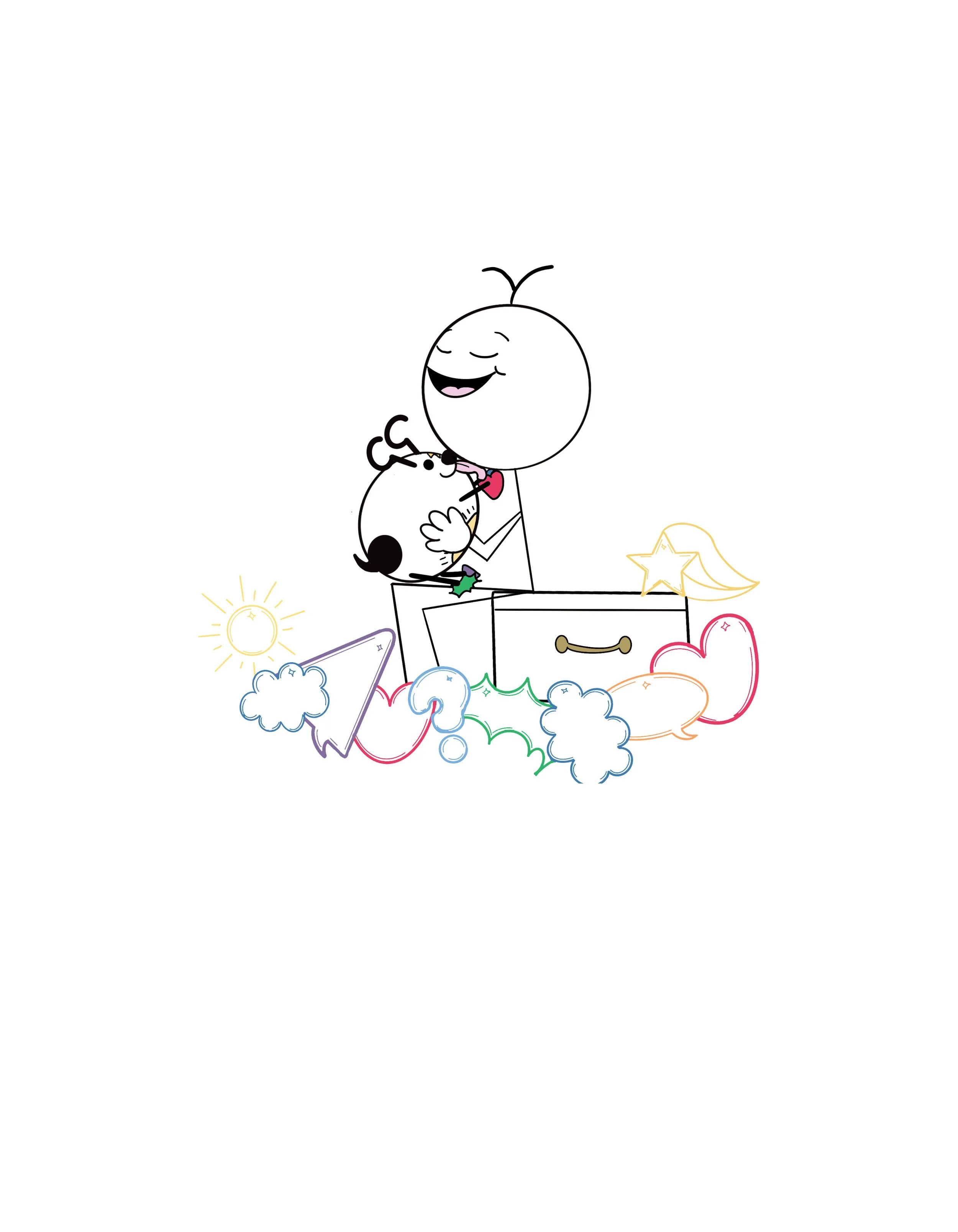
Let’s Pop Into The Bubble Chronicles
Some kids feel everything deeply, fully and sometimes seemingly all at once. Let’s face it: All of us, at one point or another, have felt pretty delicate. A comment from a peer, a missed opportunity, a hard day that just won’t let go. When the world’s messages get loud and messy, it’s easy to feel stuck, shut down, or overwhelmed.
Together, through simple, shared language and meaningful perspectives, you’ll explore how to notice what’s happening on the outside and the inside, step back, organize what you experience, recognize what actually really matters, and choose where to direct your energy.
One of the biggest things to keep in mind as you move through The Bubble Chronicles is that this is our way of preparing the mind for a compassionate response. So, it doesn’t venture into full-fledged decision-making or interpersonal communication, it is just touching on all that we personally contend with to get in the right headspace beforehand: that effective understanding of self and intrapersonal communication that primes us for success.
When we embrace this language, we stop feeling threatened by the flood of information bubbling up inside and around us. Instead of turning away or reacting just to protect ourselves, we choose to pause and look at our bubbles; because in this brief, glimmering moment, they reveal the light that was always there and remind us that every challenge holds a reflection worth understanding. With practice, we come to crave that space, that view, that knowing.
And that’s how some of the most fragile things on the planet—bubbles—help us become something surprisingly stronger than resilient: antifragile.


FAQs
-
This course is designed primarily for students in grades 2–4. While it is developmentally aligned with this age group, it can be adapted for use with both younger and older learners, including teens and adults in reflective or group settings.
-
No certification is required. The course is intentionally open and intuitive: created for educators, therapists, school counselors, community group leaders, or any other individual with a deep understanding of emotion regulation and sensory processing to use in practice. It is flexible enough to fit a wide range of settings.
-
In educational settings, The Bubble Chronicles is best used as a Tier 1 (universal) visual teaching aid (similar to a “PowerPoint”) providing cues and conversation starters for a knowledgeable adult facilitating learning. It can be used in classrooms, small groups, or one-on-one settings.
Emotional skills don’t begin with strategies; they begin with having words and images sturdy enough to think with.
-
Yes. The underlying framework can also be used to design a targeted intervention. It can help teach children (and certain adults) to slow down, ground themselves, and gain healthy psychological distance. By “mapping” an experience on paper, individuals can externalize what they’re experiencing, which helps make it visible, manageable, and open for reflection. It may be clinically adapted for use with any individual; however, it is proposed to be most appropriate for highly sensitive persons (HSPs).
Interactive engagement with content provided in The Bubble Chronicles will reveal touchpoints for occupational therapists and speech and language pathologists as it is likely to expose needs for targeted services related to executive functioning, sensory processing, literacy, communication, assistive technology, fine motor, and possible environmental modifications.
-
Mapping in this context is the act of drawing our experience using pictures and bubbles. Each bubble represents a piece of a thought, feeling, or event. It can be a calm, independent process for children, or (when facilitated by a trained adult) a powerful way to unpack and understand an issue.
-
What we say about an experience (or even what we write in a journal) may differ from what we see when we map it visually. Each bubble has limited space, so the child must decide what truly belongs there. This natural constraint helps reveal what’s most important or what’s at the core of the experience, often surfacing insights that might otherwise remain unseen.
-
Grounding is a simple technique that helps bring attention back to the present moment. It might involve noticing the breath or naming things you can see or touch.
Mapping is grounding because it helps move thoughts and feelings out of the mind and onto paper. When we draw what’s happening inside us, we slow down, focus, and become more present. The act of creating (i.e., choosing colors, shapes, or words) engages the senses and gives the mind something steady to do. This combination of movement, attention, and visual clarity naturally calms the body’s stress response and helps both children and adults feel centered and in control again.
-
Yes. Maps can evolve: growing or changing as a child’s understanding deepens. Returning to a map later can be a meaningful way to track progress or emotional growth.
-
These are questions that gently guide your attention back toward what you value. It’s the kind of question that re-anchors you: a solid place from which to build understanding. For example, if I recognize that excellence is the value at the center of a situation, I could ask myself:
What would excellence actually look like here?
Is excellence possible in this moment?
How might this reach the level of excellence I believe it could?
Do the people involved share the same idea of excellence?
To what extent are others striving for excellence, too?
Any one of these questions can serve as a gateway, or the first stepping-stone on a much longer path of problem-solving, perspective-taking, and decision-making. The question opens the gate; what happens beyond it often involves deeper reflection, communication, and action. That part (aligning your choices, words, and behaviors with your core values) is a whole world of its own…and honestly, probably its own workbook for another day.
But here, the purpose is simple: WARM questions put you on a path toward authenticity. It shifts you out of emotional overwhelm and into grounded self-inquiry. This can be especially powerful for highly sensitive people who tend to get swept away by a rush of bubbles.
Like any good tool, WARM questions work best when used with good intention. It’s not about interrogating yourself or getting the “right” answer. It’s about letting the question bring your thoughts and values back into alignment.
-
The course is informed by multiple theories and frameworks that provide the foundation for its content and structure: Systems Thinking, Social Cognitive Theory, the Transactional Model of Stress and Coping, Acceptance and Commitment Therapy (Relational Frame Theory & Functional Contextualism), Cognitive Behavioral Therapy (Cognitive Model), Mindfulness-Based Practices, Self-Determination Theory, Constructivism Learning Theory, Design Thinking, and major principles of Behavioral Economics.
-
-
A Courselings Crosswalk maps the simple ideas organized by chapter to the advanced concepts adults and professionals use: revealing the depth of the metaphor and the many possible directions educators can explore depending on the population or individual, treating each chapter as a launchpad for deeper discussion.
This crosswalk for The Bubble Chronicles includes concepts from fields such as psychology, neuroscience, philosophy, and behavioral economics. While they are sometimes used in clinical settings, they largely describe normal human experiences—how people notice the world, process information, feel emotions, and make sense of their thoughts and relationships. Learning these ideas is not about diagnosing problems or identifying pathology; rather, it helps build language and awareness for experiences that are part of being human.